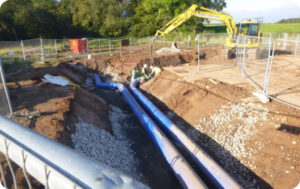
Dewatering. What is it and why is it needed during construction?
In its simplest term, dewatering is the removal of water from the ground. This water can either be groundwater from aquifers or surface water that has collected inside an excavation.
Dewatering systems will often be designed to extract both groundwater and surface water simultaneously and will use pumps and wells to remove this water from the ground.
The purpose of dewatering in construction is to control groundwater levels to enable excavation in dry and safe working conditions and to reduce groundwater pressures on underground structures.
Dry ground conditions are paramount to ensure a safe working environment inside the excavation and ensures construction can continue to take place without delay. If dewatering is overlooked during the planning stage, then the excavation can flood with groundwater and construction must stop until the water is removed and a dewatering system is installed.
The image below shows what happens when dewatering isn’t planned for. The result is impossible ground conditions to work in. The second photo shows how the ground is improved after a dewatering system is installed.
Dewatering is a temporary works technique that is required throughout the temporary work’s stage until the excavation is made waterproof, at which point the dewatering system can be switched off and decommissioned. Once switched off, the water level will return to its original level.
Dewatering is also required to reduce groundwater pressures on underground structures such as the retaining wall or base slab. In some cases, excavation to formation level can take place in dry soil without dewatering, however, beneath the excavation there may be a more permeable aquifer with a high groundwater head (artesian water pressure). When the ground is excavated, the weight of the soil is removed and the groundwater pressure can cause the soil to fail, causing uplift failure of the ground at the excavation base. This can subsequently result in groundwater flooding of the excavation. Sometimes it is necessary to install a dewatering system to lower groundwater pressures and reduce the risk of uplift failure from occurring.
In its simplest term, dewatering is the removal of water from the ground. This water can either be groundwater from aquifers or surface water that has collected inside an excavation.
Dewatering systems will often be designed to extract both groundwater and surface water simultaneously and will use pumps and wells to remove this water from the ground.
The purpose of dewatering in construction is to control groundwater levels to enable excavation in dry and safe working conditions and to reduce groundwater pressures on underground structures.
Dry ground conditions are paramount to ensure a safe working environment inside the excavation and ensures construction can continue to take place without delay. If dewatering is overlooked during the planning stage, then the excavation can flood with groundwater and construction must stop until the water is removed and a dewatering system is installed.
The image below shows what happens when dewatering isn’t planned for. The result is impossible ground conditions to work in. The second photo shows how the ground is improved after a dewatering system is installed.
Dewatering is a temporary works technique that is required throughout the temporary work’s stage until the excavation is made waterproof, at which point the dewatering system can be switched off and decommissioned. Once switched off, the water level will return to its original level.
Dewatering is also required to reduce groundwater pressures on underground structures such as the retaining wall or base slab. In some cases, excavation to formation level can take place in dry soil without dewatering, however, beneath the excavation there may be a more permeable aquifer with a high groundwater head (artesian water pressure). When the ground is excavated, the weight of the soil is removed and the groundwater pressure can cause the soil to fail, causing uplift failure of the ground at the excavation base. This can subsequently result in groundwater flooding of the excavation. Sometimes it is necessary to install a dewatering system to lower groundwater pressures and reduce the risk of uplift failure from occurring.
Article Gallery